
Hluhluwe Game Reserve — The Definitive Safari Guide for 2026
Hluhluwe-iMfolozi Park is Africa’s oldest proclaimed game reserve and the cradle of modern white rhino conservation — a place where, against extraordinary odds, the southern white rhino was pulled back from the brink of extinction. Located in KwaZulu-Natal, South Africa, it covers 960 km² (96,000 hectares) of rolling Zululand hills, perennial rivers, and ancient thornveld, offering full Big Five safaris in a landscape unlike anywhere else on the continent.
Key Takeaways
- Africa’s oldest proclaimed game reserve — proclaimed in 1895, three years before the Sabie Game Reserve, the precursor to Kruger National Park
- Birthplace of white rhino conservation — Hluhluwe-iMfolozi played a central role in saving the southern white rhino through protection and Operation Rhino’s translocation programme
- Full Big Five in 960 km² of varied Zululand terrain — lion, leopard, elephant, rhino, and buffalo
- Malaria precautions — consult a travel health professional about current risk and whether prophylaxis is recommended for your itinerary
- Two distinct sections — Hluhluwe in the north has greener, hillier terrain, while iMfolozi in the south has more open grasslands; wildlife moves throughout the park
- Accessible by road — approximately 3 hours from Durban, depending on your entrance gate, with King Shaka International Airport as a major gateway
What Is Hluhluwe-iMfolozi Park?
Hluhluwe-iMfolozi Park is a single, contiguous game reserve in northern KwaZulu-Natal, managed by Ezemvelo KZN Wildlife, the provincial conservation authority. It was formed by merging two adjacent reserves — the Hluhluwe Game Reserve (proclaimed 1895) and the Umfolozi Game Reserve (also 1895) — into a unified conservation area connected by a wildlife corridor. Together they protect one of Africa’s most ecologically diverse and historically significant wilderness areas.
The park is celebrated worldwide not just for its wildlife, but for its conservation history. By the late 19th century, the southern white rhino had been reduced to a small surviving population in what is now KwaZulu-Natal. Protection within Hluhluwe-iMfolozi helped this population recover. Operation Rhino, launched in 1961 and closely associated with conservationist Dr Ian Player, expanded efforts to capture and relocate white rhinos to establish populations elsewhere. This recovery remains one of conservation’s greatest achievements.
Where Is Hluhluwe Game Reserve Located?
The park lies in Zululand, northern KwaZulu-Natal, approximately 280 km north of Durban. It sits between the towns of Hluhluwe and Ulundi, within an ancient and culturally significant landscape that was historically the heartland of the Zulu Kingdom.
| Route | Distance | Approx. Drive Time |
|---|---|---|
| Durban | ~280 km | ~3 hours |
| Richards Bay Airport | ~100 km | ~1.5 hours |
| Johannesburg (O.R. Tambo) | ~600 km | ~6.5 hours or fly to Durban |
| St Lucia / iSimangaliso | ~50 km | ~45 minutes |
Distances and driving times are approximate and vary by entrance gate, route and traffic. Allow additional time to reach your accommodation inside the park.
King Shaka International Airport, north of Durban, is a major gateway for visitors. Richards Bay Airport is a closer regional alternative. The park combines naturally with a KwaZulu-Natal coastal itinerary, including iSimangaliso Wetland Park, St Lucia and the Elephant Coast. The Drakensberg offers an inland extension, with travel time depending on your destination.
What Wildlife Can You See at Hluhluwe-iMfolozi?
Hluhluwe-iMfolozi offers full Big Five game viewing — lion, leopard, elephant, both black and white rhino, and buffalo — alongside an exceptional diversity of antelope, predators, and birdlife that reflects the park’s varied habitats.
The Rhino Story: Hluhluwe-iMfolozi’s Conservation Legacy
Hluhluwe-iMfolozi played a central role in saving the southern white rhino, and the park remains an important stronghold for the species. Black rhino — a more solitary and critically endangered species — are also present, although their elusive behaviour makes them harder to spot. The opportunity to see both species is a highlight of visiting the park, but sightings are never guaranteed.
Big Five Wildlife Overview
| Species | Status in Park | Habitat / Range | Sightings |
|---|---|---|---|
| White Rhino | Resident population | Grasslands and bushveld | Common |
| Black Rhino | Present (critically endangered) | Dense bush and thickets | Rare |
| Lion | Resident prides | Ranges throughout the park | Occassional |
| Leopard | Resident, elusive | Woodland and dense cover | Rare |
| Elephant | Resident herds | Throughout | Common |
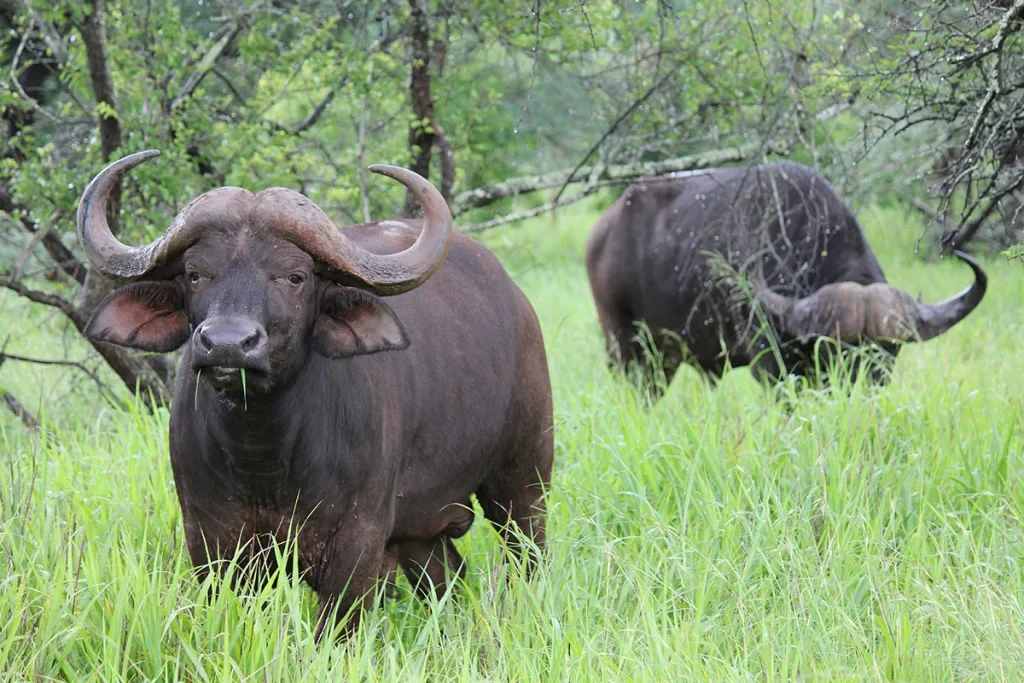
| Buffalo | Resident herds | Throughout | Common |
| Cheetah | Present (small numbers) | Open grasslands | Occasional |
| Wild Dog | Present | Ranges widely | Rare |
Birds and Other Wildlife
Hluhluwe-iMfolozi is a rewarding destination for birders, with a wide variety of raptors, kingfishers and other woodland and grassland birds. The park’s diverse habitats — from forest patches in the north to acacia thornveld and open grassland in the south — support varied birdlife.
Other mammals include giraffe, zebra, nyala, impala, wildebeest, warthog and hyena. Hippo and crocodile may also be encountered around suitable waterways, adding to the wildlife experience alongside classic game viewing.
The Two Sections: Hluhluwe vs iMfolozi — What’s the Difference?
While the two sections form a single conservation area connected by a wildlife corridor, they have distinctly different characters — and choosing which to base yourself in can meaningfully shape your safari experience.
| Feature | Hluhluwe (North) | iMfolozi (South) |
|---|---|---|
| Terrain | Hilly, dense vegetation, forest patches | Open plains, undulating grasslands |
| Best for | Black rhino, leopard, birdlife | White rhino, lion, wilderness trails |
| Vegetation | Lush, subtropical | Thornveld, open savanna |
| Wilderness Experience | Good game drives, some day walks | Famous for multi-day wilderness trails |
| Crowds | Slightly higher visitor density (main gate) | Quieter, more remote feel |
| Accommodation | Ezemvelo camps + private lodges nearby | Ezemvelo camps + iMfolozi wilderness camps |
For first-time visitors, basing yourself near the Hluhluwe section and taking a full-day game drive that loops through both sections offers the best breadth of experience. For those seeking a more immersive, off-the-beaten-track experience, the iMfolozi Wilderness Area — one of the few places in Africa where you can undertake a multi-day foot trail with an armed ranger — is exceptional.
The iMfolozi Wilderness Trails: Africa’s Most Historic Walking Safaris
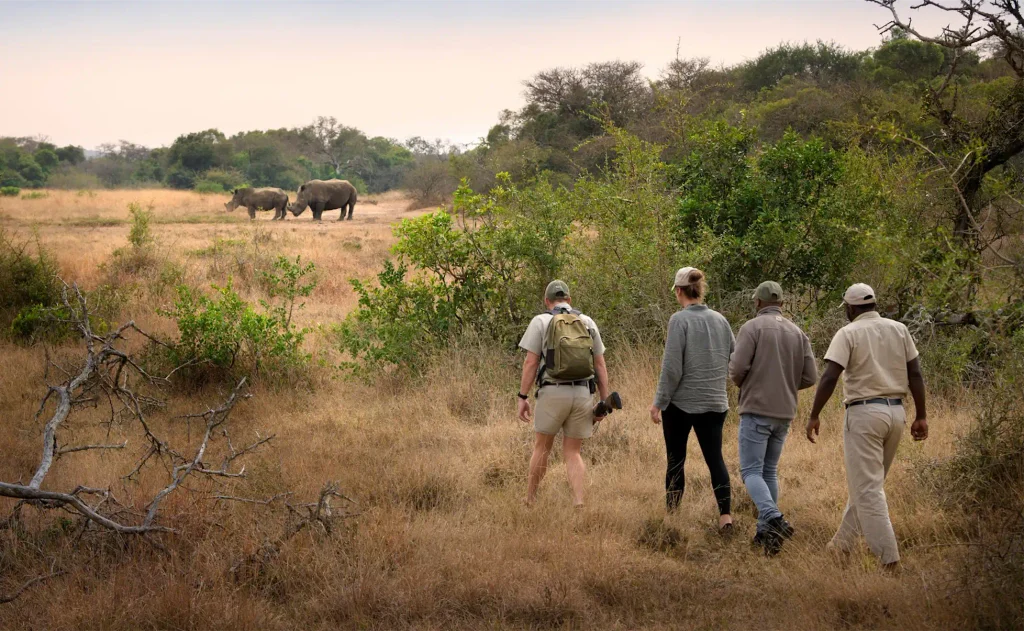
The iMfolozi Wilderness occupies approximately 23,000 ha of the southern section of the park and is one of Africa’s original and most respected walking safari destinations. Wilderness trails have operated here since 1959, pioneered by Dr Ian Player and Magqubu Ntombela, a Zulu tracker whose deep ecological knowledge shaped the modern wilderness trail concept.
Today, guided wilderness trails of 3–5 nights depart regularly, with participants carrying their own kit and camping at temporary fly camps deep in the wilderness area. There are no permanent structures — this is a genuine engagement with the African bush on foot, in the company of armed and highly experienced rangers. Close encounters with rhino, elephant, and lion on foot are part of the experience, managed with absolute professional care.
For first-time visitors, basing yourself near the Hluhluwe section and taking a full-day game drive that loops through both sections offers the best breadth of experience. For those seeking a more immersive, off-the-beaten-track experience, the iMfolozi Wilderness Area — where you can undertake a multi-day foot trail with an armed ranger — is exceptional.
Best Time to Visit Hluhluwe Game Reserve
Hluhluwe-iMfolozi is a year-round safari destination, though each season offers a different experience and advantages.
| Season | Months | Conditions | Best For |
|---|---|---|---|
| Dry (Winter) | May – September | Cool, dry, sparse vegetation | Game viewing (vegetation thins, animals concentrate at water), rhino tracking |
| Shoulder | April, October | Mild, transitional | Good all-round game viewing, fewer visitors |
| Green (Summer) | November – March | Hot, humid, lush, afternoon storms | Birdlife (summer migrants arrive), newborn animals, dramatic landscapes |
May through September is generally considered the prime game-viewing season. Rainfall is minimal, daytime temperatures are generally comfortable, while mornings and evenings can be cool, and the thinning vegetation makes spotting wildlife significantly easier. Waterholes can be productive places to look for wildlife during the dry months, although sightings vary.
The summer months (November–March) bring lush, green landscapes and the arrival of summer migrant birds, making this a rewarding time for birders. Newborn impala, zebra, and wildebeest appear in large numbers, drawing predator activity. The trade-off is denser vegetation, higher humidity, and afternoon thunderstorms that can interrupt game drives.
Where to Stay: Lodges and Accommodation at Hluhluwe Game Reserve
Accommodation at Hluhluwe-iMfolozi includes Ezemvelo KZN Wildlife camps inside the park, Rhino Ridge Safari Lodge within the park, and private lodges in the surrounding region.
Ezemvelo KZN Wildlife Camps (Inside the Park)
Ezemvelo operates several self-catering and catered camps within the reserve. These offer a more self-drive, national-park style experience, with well-located accommodation.
- Hilltop Camp (Hluhluwe section) — the flagship Ezemvelo camp, with chalets and a restaurant overlooking the Hluhluwe hills; the most comfortable public-camp option
- Mpila Camp (iMfolozi section) — the main iMfolozi camp, well-placed for rhino-rich game drives in the south; self-catering chalets and tented options
- Wilderness Fly Camps — basic camping in the iMfolozi Wilderness Area for trail participants; no permanent structures
Private Lodges In and Around Hluhluwe Game Reserve
For a more exclusive lodge experience with guided game drives and specialist rangers, options include Rhino Ridge Safari Lodge within the park and private lodges in the surrounding Zululand region. Inclusions vary by property, but may include:
- Guided game drives, with schedules and night-drive availability depending on the property
- Meals and accommodation, with beverages included or charged separately depending on the package
The Zululand / Hluhluwe area offers luxury safari travellers an alternative to the well-trodden Greater Kruger circuit — the combination of authentic conservation history, exceptional rhino sightings, and relative off-the-beaten-track positioning appeals strongly to experienced safari-goers.
How Does Hluhluwe-iMfolozi Compare to Kruger National Park?
Hluhluwe-iMfolozi and Kruger National Park are both iconic Big Five destinations in South Africa, but they offer meaningfully different experiences — understanding those differences helps travellers choose the right reserve for their itinerary.
| Feature | Hluhluwe-iMfolozi | Kruger National Park |
|---|---|---|
| Size | 960 km² | 19,485 km² |
| Established | 1895 (oldest in Africa) | 1898 (Sabie Game Reserve) / 1926 (Kruger NP) |
| Rhino | Exceptional — origin of white rhino conservation | Good, but rhino density lower per km² |
| Walking Safaris | World-class — iMfolozi wilderness trails since 1959 | Guided walks and multi-day wilderness trails within Kruger |
| Crowds | Significantly quieter | Can be heavily visited; peak season busy |
| Location | KwaZulu-Natal; Durban gateway | Mpumalanga/Limpopo; Johannesburg gateway |
| Terrain | Hilly Zululand hills, rivers, thickets | Flat lowveld, open savanna |
| Combine With | iSimangaliso, Drakensberg, Elephant Coast | Panorama Route, private Sabi Sands or Timbavati |
Hluhluwe-iMfolozi is a good choice for travellers interested in rhino conservation, Zululand scenery and wilderness walking trails. Kruger and its adjacent private reserves offer a much larger area to explore and a broad range of accommodation and safari experiences, including the renowned leopard viewing of Sabi Sands.
For the discerning traveller, combining both — two nights in Zululand’s Hluhluwe region followed by two or three nights in the Sabi Sands or Timbavati — creates one of southern Africa’s most complete safari itineraries.
Conservation Significance: Operation Rhino and the Park’s Legacy
Understanding the conservation history of Hluhluwe-iMfolozi is not a footnote to the safari experience — it is the heart of it. By the late 19th century, the southern white rhino had been hunted to near-extinction, with a small surviving population in what is now KwaZulu-Natal. Protection within Hluhluwe-iMfolozi helped this population recover.
Operation Rhino, launched in 1961 and closely associated with Dr Ian Player, pioneered large-scale rhino capture and translocation. White rhinos were immobilised, transported, and relocated to establish populations elsewhere. It was a technical, logistical, and philosophical breakthrough — and it worked. The programme played a central role in the recovery of the southern white rhino and remains one of conservation’s great achievements.
The park remains at the frontline of ongoing rhino conservation, including anti-poaching efforts, dehorning programmes, and the breeding and translocation of both white and black rhino to protected areas across the continent.
Practical Information for Visiting Hluhluwe Game Reserve
- Managed by: Ezemvelo KZN Wildlife (provincial conservation authority)
- Gates open: Year-round; gate hours vary seasonally (generally 05:00–19:00 in summer, 06:00–18:00 in winter)
- Conservation fees: Applicable for all visitors; South African residents receive preferential rates
- Self-drive: Permitted throughout the park on designated roads; a 4×4 is not required for standard game drives
- Mobile coverage: Limited inside the park — plan accordingly
- Malaria: Consult a travel health professional about current risk, mosquito precautions and whether prophylaxis is appropriate for your itinerary
- Nearest fuel and services: Available in surrounding towns, including Hluhluwe; plan fuel stops according to your entrance gate and route
- Combine with: iSimangaliso Wetland Park (a UNESCO World Heritage Site ~50 km away), St Lucia, and the Elephant Coast
Frequently Asked Questions: Hluhluwe Game Reserve
What is Hluhluwe Game Reserve famous for?
Hluhluwe-iMfolozi Park is world-famous for its role in white rhino conservation. It is Africa’s oldest proclaimed game reserve (1895), and Operation Rhino, launched in 1961, helped establish southern white rhino populations elsewhere through translocation. The park remains an important destination for seeing both white and black rhino, although sightings are never guaranteed.
Is Hluhluwe-iMfolozi safe to visit?
Yes. Hluhluwe-iMfolozi is a well-managed, established national reserve and can be visited responsibly by following standard wildlife safari guidelines — remaining in vehicles during self-drives, following ranger instructions on guided activities, and not approaching dangerous animals on foot outside of guided wilderness trail contexts. The park is in a rural area of KwaZulu-Natal; standard travel precautions apply for the surrounding region.
Does Hluhluwe Game Reserve have the Big Five?
Yes. Hluhluwe-iMfolozi Park has the full Big Five: lion, leopard, elephant, both white and black rhino, and buffalo. It is one of relatively few reserves in KwaZulu-Natal to offer a genuine Big Five safari experience. The park is particularly noted for its rhino conservation history and opportunities to see white rhino.
How far is Hluhluwe Game Reserve from Durban?
Hluhluwe-iMfolozi Park is approximately 280 km north of Durban, a drive of around 3 hours via the N2 highway. A major airport gateway is King Shaka International Airport (Durban), which is served by multiple daily flights from Johannesburg and Cape Town. For travellers arriving at Richards Bay Airport, the drive to the park is approximately 100 km (1.5 hours). Distances and driving times depend on the entrance gate and traffic.
What is the best time of year to visit Hluhluwe Game Reserve?
The best time to visit Hluhluwe-iMfolozi for game viewing is during the dry winter months of May through September. Vegetation is sparse, wildlife concentrates around water sources, and daytime temperatures are generally comfortable, with cooler mornings and evenings. For birding, the summer months (November–March) bring summer migrant species and are excellent for birdwatchers despite the heat and humidity. The park is open year-round and offers rewarding experiences in every season.
Can you do walking safaris at Hluhluwe-iMfolozi?
Yes — and it is one of the best places in Africa to do so. The iMfolozi Wilderness Area (approximately 23,000 ha in the southern section) has offered guided wilderness trails since 1959, making it one of the world’s oldest walking safari programmes. Multi-day trails are available in different formats, with accommodation, duration and equipment arrangements depending on the trail selected. Walks are led by experienced armed rangers. Day walks are also available at certain times of year. Booking well in advance is essential — these trails are popular and numbers are strictly limited to protect the wilderness experience.
Is malaria a risk at Hluhluwe Game Reserve?
Seek current advice from your physician or a travel health clinic about malaria risk for your itinerary and travel dates. They can advise whether prophylaxis is appropriate. Take precautions against mosquito bites, including using repellent and covering exposed skin in the evenings.
What makes Hluhluwe different from Kruger National Park?
Hluhluwe-iMfolozi and Kruger are both Big Five destinations, but they offer distinct experiences. Hluhluwe-iMfolozi is older and smaller, with hilly Zululand terrain and a celebrated white rhino conservation history. Its iMfolozi wilderness trails are a particular attraction. Kruger offers a much larger area, varied landscapes, guided walks and its own multi-day wilderness trails. Many experienced safari-goers combine both reserves in a single KwaZulu-Natal and Mpumalanga itinerary.
Plan Your Hluhluwe Game Reserve Safari
Hluhluwe-iMfolozi Park rewards travellers who go beyond the predictable safari circuit — its conservation history is extraordinary, its rhino encounters are world-class, and the iMfolozi wilderness trails offer a depth of experience that few reserves anywhere in Africa can match. Whether you are visiting for the first time or returning to explore the iMfolozi section on foot, this is a reserve that justifies a dedicated place in any southern Africa itinerary.
ASG — the specialist luxury safari operator — has in-depth knowledge of the Hluhluwe region, including private lodge options, seasonal timing advice, and how best to combine a Zululand safari with iSimangaliso, the Drakensberg, or a Greater Kruger private reserve extension. To begin planning, make an enquiry here and an ASG safari specialist will be in touch.